How to Propagate a Bird’s Nest Fern

Last Updated: May 17, 2022

Anyone who loves Bird’s Nest Ferns as much as we do, will also probably be desperate to know what methods you can use, as well as how easy and quick it is…

In this post we will cover the step by step process, as well as what tools you’ll need, issues you may face and all of our top tips for a successful Bird’s Nest Fern propagation.

What is propagation?

We assume that if you’ve landed on this page, you probably know what propagation is but we thought it was important to cover this basic first before getting into the finer details. Simply put, it’s is the method of growing new plants out of existing ones. This can be done through a range of methods, from taking a cutting and growing in water as well as division of the mother plant and a few other more challenging processes.

Why propagate a Bird’s Nest Fern?

Lots of people want to simply multiply the number of plants you have without actually having to open your wallet. Whether you want to expand your collection, share with friends and family or even sell off the new plants, there are so many good reasons!

You may also be forced to propagate your Bird’s Nest Fern if part of your plant is starting to die. We always recommend trying to save your plant, but taking a few spores to grow new ones is a great option in case your mother plant doesn’t make it.

What things will I need to propagate my Bird’s Nest Fern?


  • Healthy and mature Bird’s Nest Fern

  • Sharp scissors/shears

  • Spare pot(s)

  • Fresh soil and water

  • Newspaper or plastic sheet (if you’re propagating indoors)

  • Sphagnum moss

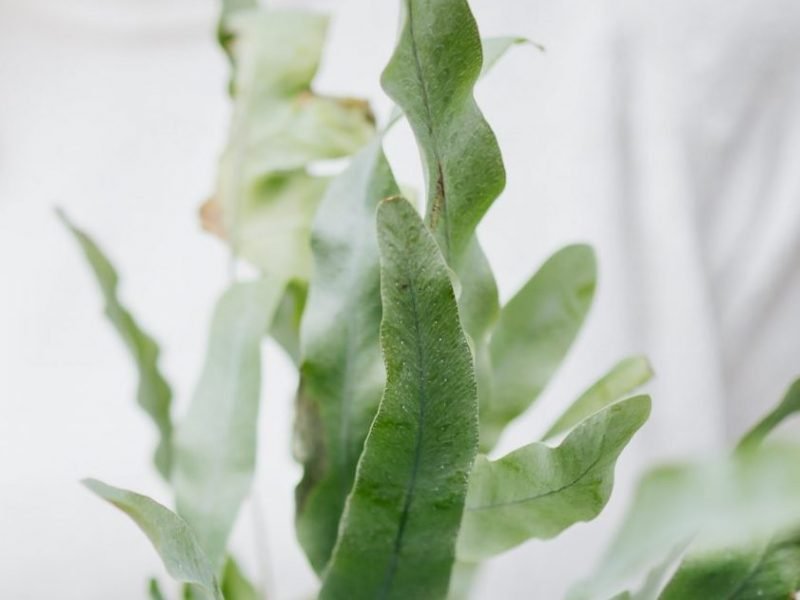
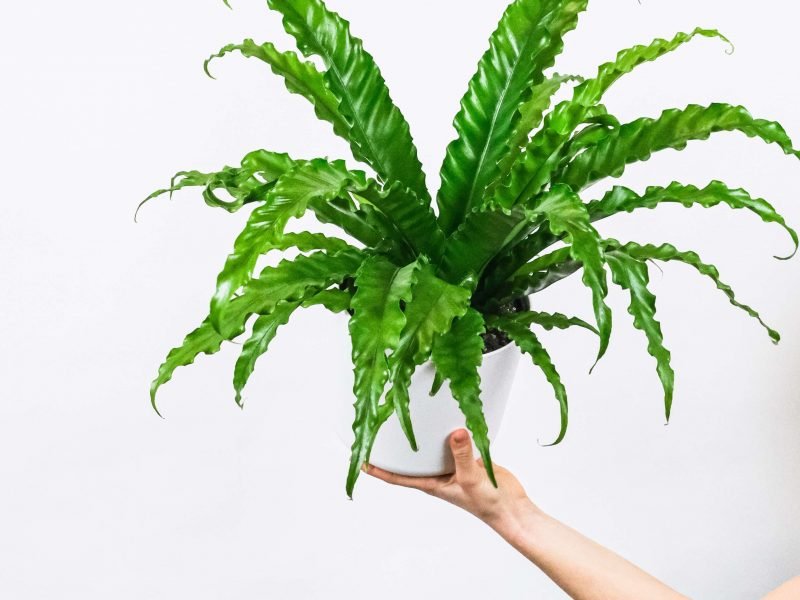
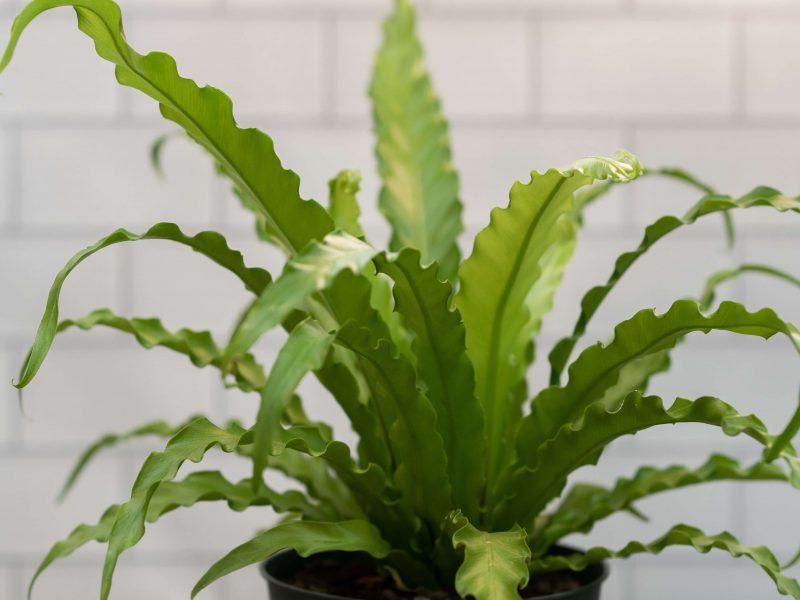
A Bird's Nest Fern

What methods can I use to propagate my Bird’s Nest Fern?

These plants are quite unique in that you can’t use any of the more common methods like stem cuttings or division. The most successful method of propagating a Bird’s Nest Fern is through spores. These appear as brown spots on the undersides of your plant which can be collected and grown into new plants. It is a little more unpredictable than the methods you might be used to but if done right, can lead to plenty of incredible ferns. Below we will go through a complete step by step of this propagation method.

How to propagate your Bird’s Nest Fern through spores


  1. Locate healthy spores

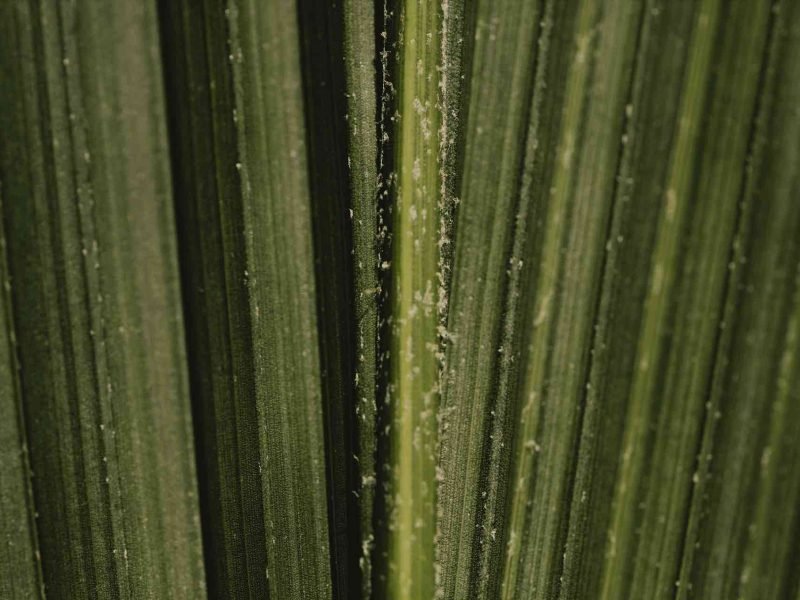
    Once your Bird’s Nest Fern matures, you may start to see spores forming on the undersides of the leaves. These look like brown fuzzy spots or lines. Make sure that when you propagate your Fern, that the spores are pump and fuzzy.

  2. Cut off the frond

    Once you have located one or more leaves (fronds) that have plump fuzzy spores, cut one or more of them off with clean, sharp scissors. One leaf should be enough but if your fern is bushy and you don’t mind taking a few more leaves off, then the more spores you use, the higher the chance that some will successfully germinate.

  3. Place the frond(s) in a paper bag

    The next step is to place the fronds into a clean, dry paper bag. Over the next few days, the spores should start to fall off the leaves into the bottom of the bag which makes it easy to collect them.

  4. Add to sphagnum moss

    Collect the spores and place them on top of a container filled with sphagnum moss. Make sure to mist the sphagnum moss regularly. This should keep the moss moist but not waterlogged.

  5. Cover with a plastic bag

    To create the perfect environment for germination, cover the container with a clear plastic bag and place in a warm, shady spot. This will lock in some of the moisture which will help the spores turn into actual Bird’s Nest Ferns.

  6. Mist the moss regularly

    Lift the plastic bag and mist the sphagnum moss regularly. You want to have some moisture in the moss, but prevent it from becoming soggy. On average, you’d look to mist every few days but adjust this if needed.

  7. Enjoy your new growth

    Germination should happen in a few weeks and growth should soon be visible. Growth across the spores will differ, some will be quicker than others and some may not even grow at all. Continue misting but remove the plastic bag once you start to see growth. After a few months, you should have several small Bird’s Nest Ferns!

Bird’s Nest Fern Propagation

Bird's Nest Fern

Bird’s Nest Fern Propagation FAQs

Below you’ll find all the answers to make sure that you have plenty of new ferns in no time!

Common problems when propagating a Bird’s Nest Fern

How to care for your Bird’s Nest Fern after propagation

Bird’s Nest Ferns are native to tropical regions so it’s important that their environment mimics this slightly. Although we can never create a tropical paradise in our home (as it would be pretty uncomfortable), there are a few little things we can do.

When it comes to lighting, Bird’s Nest Ferns like filtered light or indirect light. Stay away from any direct light as this can very quickly burn the leaves, especially when they are so young. The Bird’s Nest Fern likes to have moist but not soggy soil so it’s important to get the right balance. Don’t let the soil of your new plants dry out completely but avoid waterlogged soil at all costs. This will very quickly rot the roots of your Bird’s Nest Fern which can cause a whole range of issues, especially when they are young and their root system isn’t so established.

But it’s not just the moisture in the soil that you need to take into account after propagating your Bird’s Nest Fern but humidity too! They need a high humidity level so things like misting and pebble trays will be your best friend to aid growth of your new plants.

But there’s one thing that you don’t need to worry about at all and that is fertiliser. Ferns in general don’t really need much fertiliser and they do really well without. But you especially want to stay away from any kind of feeding on new plants. They are super sensitive to overfertilisation and it can really harm young cuttings and plants.

We hope you have found this complete guide to Bird’s Nest Fern propagation useful. It’s never an exact science and sometimes it will take a while for you to see anything happening with the spores. But with the right methods, care routine, warmth and light level you should find some success.

Check out our detailed Bird’s Nest Fern care guide to find all the information on how to continue to care for your new plants!

Fiddle and Thorn is a participant in the Amazon Services LLC Associates Program, an affiliate advertising program designed to provide a means for sites to earn advertising fees by advertising and linking to Amazon.com

Take our houseplant survey!

Quickly respond to our 30 second houseplant survey and get 75% off our Complete Houseplant Care eBook!

Take the Survey

No thanks…

How to prevent pests on your houseplants

Last Updated: December 31, 2021

There is so much advice out there about how to get rid of pests once they have taken a hold of your houseplant, but it’s not as common to find advice about how to prevent them in the first place. Pests can be a real nightmare for plant parents, they are difficult to get rid of if you don’t spot the problem early and they can very quickly kill your plant if not treated.

How can you prevent houseplant pests?

Don’t worry! we have learnt the hard way to figure out the top 8 things you can do to prevent pests from settling on your plant to begin with. They aren’t difficult and don’t really require any extra cash so you’ll want to implement these ideas straight away!

Inspect a plant carefully before you buy it

When you bring a new plant home, whether that’s from your local nursery, plant shop or even just from a friend, you want to inspect it fully before choosing to purchase and bring it home. Give the plant a thorough once over looking for yellowing leaves, brown spots, white powder, webbing across the leaves, holes in the leaves or even simply visible pests. Plants are kept very close together in transport to nurseries so it can happen that pests find themselves at home on your new plant.

Another way to make sure you aren’t introducing pests into your urban jungle is by isolating your new plant for two weeks before bringing it closer to your other plants. This gives some time for you to keep an eye on your plant to see if any of the above symptoms are showing up. Pests reproduce pretty quickly so if after two weeks you still don’t spot any insects or signs then you should be all good.

Always use fresh potting mix

When the time comes for you to propagate or repot any of your plants, always make sure you are using fresh pots and fresh potting mix. Pests can hide out in soil without you noticing so it can be very easy to accidentally spread the pest infestation by reusing old soil.

There is a risk that your fresh potting soil may have some bugs in it too so we always recommend buying a high-quality mix from a reputable brand and inspecting it before popping your plants in. Use a magnifying glass to go through a little bit of the mix as you should be able to spot bigs moving around if there are any.

Clean your plant tools before and after use

Another place you may find pests lurking around is in your houseplant tools and equipment. It’s really important that you clean your shears, scissors, pots and gloves before and after handling your plants. This will eradicate any risk of transferring unwanted guests between your beloved houseplants.

Cleaning your tools is also a great habit to get into to prevent coming into contact with toxic sap from plants. Whilst some houseplants are completely safe for humans and pests, there are some that can cause skin and stomach irritation. This is why it’s also really important to clean your tools to avoid yourself, others or your pets coming into harm.

Don’t let the leaves of your different houseplants touch

One of the most annoying things about houseplant pests is that they can jump across leaves and across plants. Although it looks great to have a group of houseplants all grouped up, this is a danger when it comes to pests. If even just one of those plants develops a few nasty pests, they’ll soon be able to climb around the plants close by and the infestation will be pretty unstoppable. Therefore, we recommend putting your more special or expensive plants a little further away from other houseplants to decrease this risk.

Regularly inspect your plants

As with new plants, it’s also really important to regularly inspect all of your houseplants to spot not only pests but early warning signs that something isn’t quite right. This will help spot the issues or the infestation early, giving you the best chance at fixing it and bringing your plant back to full health.

Use a magnifying glass to inspect the leaves, stems and potting mix of each of your plants carefully. Brown or yellow spots, webbing, powder or holes in the leaves as well as visible insects are the main things to look out for. When inspecting your plant, look very closely at the undersides of the leaves as this is where pests like to hang out.

Regularly shower your houseplants

Introduce showering as part of your monthly care routine for your houseplants. It’s a great way to not only get rid of dust on the leaves but it will wash away any pests that may be secretly hiding in your plant. The amount of water pressure you use depends on the delicacy of the plant stems and leaves but giving them a wash once a month will really boost their natural shine as well as reduce the risk of pests.

Care for each of your plants in the right way

Plants that are unhealthy or unhappy are much more susceptible to pests and diseases as they aren’t strong enough to fight them. Waterlogged soil, dry air and incorrect lighting are also the perfect breeding conditions for various pests so always make sure you’re giving each individual plant the conditions that it needs to thrive.

Good air circulation

Another thing that is often overlooked when caring for houseplants but it can be really beneficial to help with water evaporation from misting, stopping hotspots occurring and preventing condensation on the leaves which then reduces the risk of fungal infections and rot. By increasing the air circulations through fans and open windows it will help your houseplants to be healthier and less susceptible to pests.

Those are our 8 key ways to help prevent a pest infestation on your beloved houseplants. There is of course no way to guarantee that your plants may not occasionally house a few bugs, but by following these steps, you’ll definitely reduce the risk significantly. It’s better to act now whilst your houseplants are still healthy and prevent the pests in the first place, than wait until you have an issue to fix as sometimes plants can’t survive a pest infestation and you may have no choice but to throw your plant away.

Fiddle and Thorn is a participant in the Amazon Services LLC Associates Program, an affiliate advertising program designed to provide a means for sites to earn advertising fees by advertising and linking to Amazon.com

Take our houseplant survey!

Quickly respond to our 30 second houseplant survey and get 75% off our Complete Houseplant Care eBook!

Take the Survey

No thanks…

How to prevent, diagnose and fix root rot

Last Updated: August 3, 2022

What is Root Rot?

Root rot is one of the worst conditions your houseplants can develop. It generally occurs when the roots of your plant have too much moisture, normally caused by; overwatering, poor drainage or badly draining soils. In mild cases, root rot can be fixed by letting the soil properly dry out and taking up better watering habits. When the infection gets worse the best way to fix root rot would be to repot your plant, trimming away any infected roots and dying leaves in the process. This isn’t a guaranteed way to save the plant, but it can’t hurt to try!

How to diagnose root rot

Spotting root rot can be a little tricky as most of the initial symptoms can also be related to other issues with your plants care, such as; yellowing leaves, slow growth or moist soil.

A dead give away for root rot is mushy stems or wilting leaves starting from the base of the plant. Seen as though the roots are first to go the problems will always work their way up, so if you catch it when it’s lower down you have a far better chance of saving the plant. If you spot any of these issues, it might be worth taking a look at the roots by popping your plant out of the pot for a second and looking for brown or mushy roots.

If left too late the entire plant could simply topple over. With no roots left to support it and hold it into the soil and the stem becoming mushy at the base the plant will just fall. At this stage, there’s really no solution. You could, however, try to take cuttings from healthy areas of the plant to propagate.

How to fix Root Rot

Root rot can be a tricky condition to deal with in houseplants. If you catch it early then it can be quite simple to resolve, but if left too late then it’s often a death sentence for your plant.

Let the soil dry out (for mild cases)

Great, you’ve spotted the signs early and have caught the root rot before it has properly taken hold. The next step is simply to let the soil dry out a little bit. Pause on watering your plant for a few days and make sure you can tick off all of the list items below:

  • Remove anything from the surface of the soil (dropped leaves, wood chips etc…)
  • Check the pots drainage holes are not blocked
  • Make sure that the saucer or tray is emptied regularly

Repot the plant and trim the roots (for bad cases)

If you’ve missed most of the signs and your plant is now in the midst of a fight with root rot then it’s time to make a big move. You’ll want to repot your plant and trim off all of the unhealthy roots and leaves.

The best way to go about this is to remove the plant from the pot completely, then pick away the majority of the soil with a chopstick. From there you’ll want to wash the roots of any more soil under the tap, this will make it very easy to see the healthy white roots from the infected brown, mushy roots.

Then trim all of the infected roots with some sterilised scissors or shears, you can just use a little hand sanitiser on the blades. Making sure to clean and re-sanitise them afterwards. Once you’ve finished on the roots, roughly estimate the percentage of remaining roots compared to when you started and remove the same amount of leaves. It’s important at this stage to also trim off any buds or flowers.

Trimming off all of these leaves might seem like a strange move, but it’s done so that the smaller amount of roots can still maintain the health of the plant.

From there repot the plant in some well draining soil and take up good watering practices. With any luck the root rot won’t return.

What causes root rot?

Root rot is a condition caused due to pathogens that live in high moisture environments. Generally, it takes hold because of overwatering and poor drainage in the pot/soil. As the leading causes of root rot are so straightforward, with proper maintenance it can be easily prevented.

Overwatering

The key factor in most cases of root rot is overwatering, this results in soils with a very high moisture level which is exactly what it needs to quickly begin developing.

Non-draining soils

Generic potting mix is normally okay for most of your houseplants, but you should consider how well the soils you’re using can drain off excess water. If you’ve not got the best watering habits then your soil could be holding onto far more liquid than it should be.

Non-draining pots

Most plant pots will have drainage holes in the bottom of them, this lets out any extra liquid and stops the soil from getting waterlogged quickly. Though it’s not uncommon to find that the pots you bought your plants in haven’t had the holes punched out correctly, they’re blocked up or they simply don’t have them at all. Make sure to check all your pots and create holes at the bottom if needed.

Impermeable pot materials

Although clay or terracotta pots can be a little bit more expensive or breakable, their upsides are much more than just the better look. The clay they’re made of is permeable which means that some of the water in your soil can evaporate through the sides of the pot. This isn’t the case for the plastic pots that most use, which instead hold in all of that moisture.

Complete Houseplant Care eBook

Our comprehensive (and rather good looking) eBook that will teach you everything you need to know to successfully care for, and maintain your houseplants!

Buy on

How to prevent root rot

As root rot can be so destructive to your houseplants, it’s best to put good measures in place to stop the condition forming in the first place. In this case, it’s far better to be prepared than reactive when you start seeing signs of sickness in your plants.

The best way to prevent root rot is by maintaining good watering habits for your plants, letting them dry properly, and allowing a good amount of drainage in your soil and pots.

Maintain good watering habits

As always with houseplants, root rot prevention mostly comes down to a good knowledge of when to water your plants and when to leave them alone. The normal test that we use is simply pressing your finger into the soil to the first knuckle, if the soil is a little dry then give it a little water, if it’s moist then leave it be.

It’s a good idea to get to know the weight of your plants both before and after watering. This allows you to understand if you need to give them some more water simply by giving them a little lift.

Increasing soil drainage

You can very easily increase the amount of drainage in your houseplants’ soil by mixing perlite with your soil, this will make it far easier for water to flow through the soil and out of the drainage holes of your pots. Another easy step is to add a few small stones or pebbles to the bottom of your pots, this helps in making sure that the drainage holes are never blocked by soil or debris from your soil.

Check your pots

An easy way to prevent root rot is to make that the pots you’re using have good drainage holes in them, and the trays or saucers beneath them are regularly emptied. This ensures that your plant is never sat in water for too long, resulting in a far lower chance for over-saturation.

Fiddle and Thorn is a participant in the Amazon Services LLC Associates Program, an affiliate advertising program designed to provide a means for sites to earn advertising fees by advertising and linking to Amazon.com

Take our houseplant survey!

Quickly respond to our 30 second houseplant survey and get 75% off our Complete Houseplant Care eBook!

Take the Survey

No thanks…

How To Prepare Your Houseplants For Summer

Last Updated: May 11, 2023

As the warmer weather arrives, your houseplants will be slowly coming out of their dormant phase and will start to produce new growth once again. However, just as you would be thinking about spring cleaning your home, there are also a few things we recommend doing in the run-up to summer to prepare your houseplants for the warmer weather.

In this article, we will take you through our top recommendations for how to prepare your houseplants for summer!

Prune any leggy growth

During the winter months, it’s common for houseplants to become a bit leggy. This is because of a lower light level so it is often unavoidable. You will commonly find leggy growth on trailing houseplants and you’ll see a lot larger gaps between the leaves on the vines.

This leggy growth isn’t damaging to your houseplant we still recommend pruning it for two reasons. Firstly, it’s likely that the leaves are smaller which means they will pull in less light for photosynthesis and not be as useful to your plant. The second reason is purely for aesthetics as it will keep your plant looking fresher.

Adjust your watering routine

You’ve probably now become used to the reduced watering rate that your houseplants needed over autumn and winter. However, now that spring and summer are fast approaching, you’ll need to adjust your watering routine so ensure you’re increasing either how much water you give your houseplant each time, or how frequently you are watering.

The warmer weather will dry out the potting mix faster and your houseplant will need more moisture than it did in winter so this is a crucial one.

Clean the leaves

Although we always recommend cleaning your houseplants’ leaves at regular intervals throughout the year, make sure that you are giving them an intense clean in spring. You want to make sure that you remove any dust or dirt from the leaves to maximise the light exposure and aid photosynthesis.

Depending on the delicacy of your plant, you can either use a feather duster or a cloth to wipe across the leaves.

Begin your fertilizing routine

If there’s one rule to fertilizer that you remember it’s to never feed your plants in autumn and winter. This is the dormant period and you won’t be seeing much (or any) new foliage during these months. Feeding your houseplants during this time can be more damaging than beneficial so hold off until spring to start again.

There are a few different ways you can fertilize your houseplants but we prefer the liquid fertilizer method. It’s a great way to control how much you are feeding them.

Alternatively, you can use fertilizer sticks or pellets that you add to the soil.

Repot if rootbound

Spring is the best time to repot your plants (if they need it) because the warmer weather will hopefully enable them to grow into the new pot. Always check for signs of your plant being rootbound in spring and increase the pot size if they are.

Signs that your houseplant is rootbound include roots coming out of the drainage holes at the bottom, roots popping out of the top of the pot, roots being tightly coiled and a lack of new growth during spring and summer.

One thing to note as well when repotting your houseplant is to not choose a pot that is a lot bigger than the previous one. Not only does this increase the soil to root ratio which increases the risk of root rot as the soil takes longer to dry out, but it can actually cause your plant to become unstable.

Refresh the soil

Spring is a great time to refresh the potting mix for your houseplants which boosts the nutrient level. This is an optional one but still something that we recommend doing at least every other year.

Over time, your plant will suck the nutrients out of the soil in its pot, so refreshing it helps to increase the nutrients that your plant has available to them.

When refreshing the soil, replace one-half or two-thirds of the overall volume with fresh, high-quality potting mix.

Those are our main recommendations for ensuring that you are preparing your houseplants for the warmer weather. By following these steps you’ll often be rewarded with large luscious growth throughout the sunny months and will go a long way to keeping your plant happy and healthy.

Fiddle and Thorn is a participant in the Amazon Services LLC Associates Program, an affiliate advertising program designed to provide a means for sites to earn advertising fees by advertising and linking to Amazon.com

Take our houseplant survey!

Quickly respond to our 30 second houseplant survey and get 75% off our Complete Houseplant Care eBook!

Take the Survey

No thanks…

How to Know When Your Plant Needs Repotting

Last Updated: July 22, 2022

Repotting is one of the most forgotten aspects of plant care because a lot of emphases is often put on how much to water them and how much light they need. However, when not repotted for a long time, the roots can become overcrowded and this can start to cause real issues for your houseplants. 

However, don’t fret as we have written this guide to tell you everything you need to know about when to repot your plant. Below you’ll find the telltale signs that your plant is in need of a bigger pot.

Roots are coming out the bottom of the pot

One of the easiest ways to know if your houseplant needs repotting is to check the underside of the pot to see if roots are growing out of the drainage holes. If yes, then this is a sign that your houseplant needs to be replanted into a larger pot as the space it has is not enough. 

If there are only a few very small roots coming out of the drainage holes slightly, then you can probably wait a month or two if you have to but if more substantial roots are forming out of the pot then it’s time to repot now. 

The reason for this is that when you repot a plant that has roots coming out of the drainage holes, there is a high chance that you might break a couple when removing the plant from the pot. If these are large roots then this can cause shock-related issues for your plant so it’s best to do it before it’s gotten to this point. 

Roots visible on top of the soil

As well as roots growing out of the drainage holes at the bottom of the pot, if roots are popping out of the top of the pot then this can also indicate that your plant needs repotting. Often these are quite large and sturdy roots that come to the surface as the soil compacts so it’s important to cover these when you repot your plant so that they don’t become damaged. 

Roots are tightly wrapped

Another way to know if your plant needs to be repotted into a larger pot is to remove it from its pot and check the root system. If the roots are very tightly wrapped in circles then it means the root system requires more space. 

If the roots are still growing quite straight and there is a lot of potting mix then your plant doesn’t need to be repotted just yet. 

We recommend removing your plant from its pot every so often so that you can check not only whether it needs repotting but also to check on the health of the root system. Most issues will start with the roots and will only progress to the rest of the plant once the issue has been going on for a while. By checking the root system it allows you to spot any problems quite early. 

Growth is stagnant

If your houseplant hasn’t been growing any new leaves during the growth period of spring and summer then this can also suggest that it needs to be transplanted into a larger pot to give the roots more space to help the plant mature. 

There can be other reasons though for stagnant growth so it’s worth checking the root system before making any changes. 

If you’re seeing slow or stagnant growth during winter then don’t jump to the conclusion that your plant needs repotting. This is totally normal over the colder darker months of the year. 

The pot looks too small for the plant

Aside from checking the root system, another obvious way to know if your plant needs repotting is by comparing the size of the pot to the plant. This is often clearer in bigger plants because sometimes it can look really odd for tall plants to have little tiny pots. This is an indication that your plant needs to be repotted into something bigger. 

Plant losing leaves

If your houseplant is losing leaves, one of the issues could be that your plant is rootbound and cannot sustain the current leaves and new growth at the same time. Check the root system and other environmental aspects to confirm. It’s important that you don’t repot your plant until you are sure this is the issue as if there is something else going on, repotting an already struggling plant can cause more serious problems. 

Our top tips for repotting your houseplant

Try to repot in spring

The best time of year to repot your plant is in spring. This is because there is plenty of sunny warm weather ahead to help your plant get over the shock of repotting and also make the most of the new space to grow new healthy bigger leaves. 

If you have to repot in winter because of another issue then make sure that all other environmental factors such as sun, warmth and water are as close to what your plant needs as possible. This will help to minimise any problems caused by overwatering. LED grow lights can help in darker months. 

Only increase pot size slightly

You might be thinking that choosing a much larger pot will avoid you having to repot any time soon and will give your plant plenty of space. However, it’s important that you only increase the pot size diameter by a few centimetres. This is for two reasons; firstly, larger pots mean more soil which takes a lot longer to dry out which can cause issues such as root rot and secondly too much extra soil can make your plant unstable.

Never reuse old potting mix from other plants

You might be tempted to reuse some old potting mix from some of your other plants when repotting but that can actually be risky. There can be a lot hiding in potting mix such as bacteria and pests that you will then expose your other plant to. This is why we always recommend using new soil.

Fiddle and Thorn is a participant in the Amazon Services LLC Associates Program, an affiliate advertising program designed to provide a means for sites to earn advertising fees by advertising and linking to Amazon.com

Take our houseplant survey!

Quickly respond to our 30 second houseplant survey and get 75% off our Complete Houseplant Care eBook!

Take the Survey

No thanks…

How to Know if your Houseplant Needs Watering

Last Updated: August 6, 2022

Watering houseplants the right amount is probably the biggest worry of houseplant parents because the impact of wrong watering habits can be pretty devastating.

There is a lot of advice and countless tips on how to avoid overwatering and check if your plant is overwatered, but there is less discussion about the other extreme. How do you actually know when your plant is ready for water and make sure you aren’t underwatering your beloved plant?

Well fret no more, in this article we will be going through several ways to know if and when your plant needs watering so say goodbye to crispy roots and drooping leaves.

Test the weight of your plant

Before we start, we just wanted to point out that this one applies to small and medium plants only (so don’t go picking up those large Fiddle Leaf Fig Trees). One tip we always recommend to plant parents is to get to know the weight of their houseplants before and after watering. Just by picking up your plants at regular intervals throughout the week you will start to get a good understanding of how light your plant becomes when it’s in need of water.

Although this method isn’t an exact science, it’s a great way to quickly check in with your plants and keep track of how quickly the potting mix is drying out. It will also help you figure out how environmental changes such as seasonal differences in light and temperature impact how fast the soil is drying out. You can then adapt your watering schedule accordingly.

Your plant is drooping or wilting

One visible sign that your houseplant is in desperate need of some water is a droopy or wilting plant. Sometimes the stems begin to droop down a little and other times the leaves look a bit limp and wilted. The specific signs depend on the plant type and variation so make sure to check out the care guide and information on your specific type of plant to see how that would manifest itself.

Some houseplant types are definitely more dramatic when it comes to drooping down. Peace Lilies for example will heavily droop and become quite limp at any sign of dry soil. They can very quickly get the point of looking as though they are dying but will bounce back within minutes of getting water.

Most often, the drooping is reversible and you’ll often see your plant looking a lot perkier within hours of watering so whilst a drooping plant shouldn’t be the biggest concern, it can lead to more serious issues if you don’t water quickly.

The soil has come away from the side of the pot

One thing to look out for when spotting very dry soil is that it has started to come away from the sides of the pot. You’ll often see a little gap a few millimetres or a centimetre wide. This indicates that the soil has compacted and needs more water.

Instead of just pouring lots of water on your plant, the best thing to do is either soak it in a bowl or water a little bit every couple of hours for a day. The reason is that if you just pour a bucket of water over your dry plant, most of the water will run straight down the gap in the side of the pot and out of the drainage holes. By soaking your plant, you are ensuring that it is reaching the root system.

Look at the colour of the potting mix

Another way you can tell if your plant needs water is by looking at the colour of the potting mix. Dry potting mix will be quite light brown in colour and soggy soil will be a much darker shade of brown.

This might take some getting used to, much like the lifting technique, where it’s good to monitor the colour before and after watering so you know what to look out for.

Test the soil moisture to confirm your plant needs watering

The most obvious way to know if your plant needs water is to test the moisture in the soil. Alongside the other techniques, we often recommend you do this before watering to be sure.

There are several ways you can test the moisture levels in the soil. Firstly, using the chopstick method. We’ve written a more detailed guide on the chopstick method of moisture testing but the best thing to remember is if the chopstick comes out clean, the soil is dry.

The most reliable way of testing soil moisture though is through a moisture meter. They are really affordable and small devices that you just pop into the soil and it will tell you how moist or dry the soil is.

These are great to use on bigger plants that you aren’t able to lift, and those with really sensitive root systems where even the slightest mistake in watering can have a big impact. We always use this moisture meter from Amazon and it’s really helped in keeping our houseplants happy.

Those are the best ways to tell if your houseplants need water and over time you’ll become more accustomed to what each of your individual plants needs and when.

One of the most important things when it comes to watering your plant is adjusting the schedule throughout the year and in response to any unexpected changes.

We recommend against rigid watering schedules because they don’t take into account changes in temperature, light, humidity and other environmental factors that play such a large part in how much water a plant needs.

The other important thing to consider is what your individual plant type needs. Start by looking through our Plant Index to find 100+ care guides on all types of houseplants and they will give you a good indication of how much moisture your plant needs.

Whilst some thrive in dry soil, others need constant moisture to prevent their root system from crisping up. Use this as an initial guide and adjust your watering habits depending on what your individual plant needs.

Fiddle and Thorn is a participant in the Amazon Services LLC Associates Program, an affiliate advertising program designed to provide a means for sites to earn advertising fees by advertising and linking to Amazon.com

Take our houseplant survey!

Quickly respond to our 30 second houseplant survey and get 75% off our Complete Houseplant Care eBook!

Take the Survey

No thanks…

How to increase humidity for your houseplants

Last Updated: December 31, 2021

What are the best ways to increase humidity?

Keeping the humidity levels correct for your plants can be a bit of trial and error. We’ve found that the best ways to increase the humidity for your houseplants are; Misting, Keeping a pebble tray, Showering your houseplants, Placing your houseplants in the bathroom and utilising humidifiers. Testing a couple of these simple tips and tricks should make super easy for you to increase the humidity for your houseplants, keeping them happy and healthy.

Misting your houseplants

Although a short term solution, one of the simplest ways to increase the humidity for your houseplants is to mist them with a spray bottle. It’s best to mist them a couple of times a week and important that you only do it for humidity loving plants like ferns or monsteras. You can get spray bottles of all different kinds too that will definitely suit the style you’re looking for — we love these amber bottles.

It’s best to mist your houseplants in the morning so that all of the water that lands on the leaves and stems has time to evaporate and bring that humidity right up.

Complete Houseplant Care eBook

Our comprehensive (and rather good looking) eBook that will teach you everything you need to know to successfully care for, and maintain your houseplants!

Buy on

Pebble Tray

This method is great for keeping a more consistent humidity level for the immediate vicinity. It’s pretty simple too, just place your houseplants over a tray of pebbles with fresh water over the top. Over the day water from the tray will evaporate giving the plants above exactly what they’re looking for. The pebbles stop the bottom of the plant pots reaching the water in the tray, ultimately stopping your plants from getting waterlogged and developing nasty problems like root rot.

It’s best to fill with a small amount of water every couple of days instead of filling the tray and letting it sit for weeks. This reduces the risk of any stagnant water gathering a bad smell in your home.

Showering your houseplants

To quickly raise the humidity and wash down your houseplants of any long-standing dust, you can always give them a quick shower. Simply pop them in the shower and wash them down with lukewarm water, this will clean off the leaves and give the soil a good soaking. Once washed leave them in the shower a little to let any excess water run off before returning to their normal spots. Over the next couple of days, your plants should have a good boost in humidity levels. You can read more about how to shower your houseplants here.

Place your houseplants in the bathroom

If you’re lucky enough to have great lighting in your bathroom you can move in a couple of your houseplants that need the help of increased humidity. The running water will vastly increase the humidity of the room, especially if you often use the showers.

A top of being great for the plants, it’s also really nice to include some greenery in your bathroom as they bring a good amount of life to any room. Some recommendations for bathroom plants would be anything tropical (Monsteras, bananas etc…) or ferns, these will thrive in the increased humidity environment and look great!

Humidifiers

Looking for the easy solution? Getting a humidifier is definitely the way for you. They’re relatively affordable little devices and they make keeping a consistent humidity level so much easier. Most will allow you to place them on a timer so they run on a fixed schedule, and some will even have a built-in monitor so they automatically turn on and off to keep the humidity exactly where you want it.

This is likely the best way to go if you find that you just can’t keep the balance right with any other option, or if you travel often and can’t keep to a consistent schedule for misting or refilling a pebble tray.

There’s a whole host of ways to help increase the humidity for your houseplants. Most of the methods that we’ve gone over here are really very simple to bring into your maintenance schedule and will keep all of your plants happy and thriving through the colder, drier months.

Fiddle and Thorn is a participant in the Amazon Services LLC Associates Program, an affiliate advertising program designed to provide a means for sites to earn advertising fees by advertising and linking to Amazon.com

Take our houseplant survey!

Quickly respond to our 30 second houseplant survey and get 75% off our Complete Houseplant Care eBook!

Take the Survey

No thanks…

How to Increase Drainage for your Houseplants

Last Updated: August 1, 2022

Waterlogged soil and root rot can be one of the biggest problems for plant parents because it can very quickly cause serious and sometimes irreversible problems for your plants. One of the best ways to avoid the soil becoming waterlogged is to make sure there is good drainage in the pot and soil. This means that even if you do accidentally overwater your plant, the drainage will mean that excess water is able to escape from the pot, rather than leading to waterlogged soil and root rot.

Below we will go over some of the easiest ways to increase drainage in your potted plants. Although some require a little bit of investment, it’s a lot cheaper than buying new plants that for sure!

Adding perlite is a great way to increase drainage

We strongly recommend that every plant parent has a bag of perlite that they can add to the potting mix for plants that prefer drier soil or have delicate roots. Perlite aids both drainage and aeration in the soil so a great addition to the soil.

Perlite is a volcanic rock that is natural and pH neutral so works really well for use in potting mix. It’s white in colour and super lightweight and porous. The reason why it’s so good at both drainage and aeration of the soil is that it helps loosen up the potting mix, takes in water and prevents the soil from becoming too compact.

It’s worth checking on the packaging of your potting mix whether or not it already contains perlite. Most potting mixes that say they are well-draining or are succulent/cacti mixes should contain perlite already which will go a long way to keeping the roots free of root rot.

Terracotta pots are great for increasing drainage

This requires a little bit more monetary investment as terracotta pots are definitely more expensive than plastic ones, but their benefits are incredible. The reason that terracotta pots are great for drainage is that they are permeable and excess water can slowly escape out of the sides of the pot. This is great for any accidentally overwaterers as not all of the moisture will be trapped in the soil. It also means that if the drainage holes (more on that later) are blocked by something, water can still escape out of the side.

Houseplants are often sold in plastic pots but don’t think that this means they are the best thing for your houseplants. Plant shops and nurseries use them as they are cheaper to buy, a lot lighter to transport and are pretty unbreakable. However, plastic pots retain all of the water so aren’t suitable for succulents and cacti which require really dry soil.

There is one big disadvantage to terracotta pots though that is important to note. They don’t do so well if you are growing your plants outside in cooler temperatures. It can lead them to break and crack so it’s best to only use terracotta pots on plants grown indoors or those grown outdoors only in summer.

Drainage holes are essential to aid drainage

If you are struggling to understand why your pot keeps getting waterlogged and the roots on your houseplants are always rotting, then the first thing we would do is double check the pot you are using has holes at the bottom, these are called drainage holes. Whilst ceramic and concrete pots might look great, many of them don’t have drainage holes which means there is nowhere for any excess water to escape to.

When your pot has drainage holes in, you of course need something to capture any excess water that flows out the pot (if you are top watering). Using either planters or saucers will allow you to remove any excess water about 15-30 minutes after watering. This allows the soil to take in just as much water as it needs and goes a long way to preventing waterlogged soil and root rot.

Another thing that you need to check every now and again is that the drainage holes are not being blocked by anything that might be preventing any excess water from flowing out of the pot. Clumps of soil or debris can linger at the bottom of the pot. The best thing to do is poke the drainage holes every now and again to loosen up the soil at the bottom of the pot. It’s also a good idea to lift up your plant every now and again as it can help you spot if a large number of roots are popping out of the drainage holes. This would suggest that your plant needs to be repotted into a slightly larger container.

Those are the top 3 methods to help aid and increase drainage in the pots of your houseplants. Drainage can sometimes be a bit of a forgotten element when it comes to plant care as a lot of focus is on how much/ how often you need to water and not on what happens with the moisture in the soil. Alongside perlite, there are some other things you can add to the potting mix such as coarse sand but we tend to recommend perlite as it is easily available and also has the benefit of loosening the soil in a way in which it can aerate well on top of aiding drainage.

If the problem has already progressed to the point at which the roots have begun to rot and it has impacted the health of your plant then you might find out guide to root rot useful. We cover how to diagnose the issue as well as treat it as quickly and effectively as possible.

We also recommend looking through our Plant Index to find the specific needs of your houseplants so you know how much to water your plants but also how much drainage they need. Some plants such as cacti and most succulent types need really dry soil whereas others can deal with plastic pots and their lack of drainage pretty well as they thrive in soggy soil.

Fiddle and Thorn is a participant in the Amazon Services LLC Associates Program, an affiliate advertising program designed to provide a means for sites to earn advertising fees by advertising and linking to Amazon.com

Take our houseplant survey!

Quickly respond to our 30 second houseplant survey and get 75% off our Complete Houseplant Care eBook!

Take the Survey

No thanks…

How to Grow Roses in Pots: The Complete Guide

Last Updated: June 29, 2023

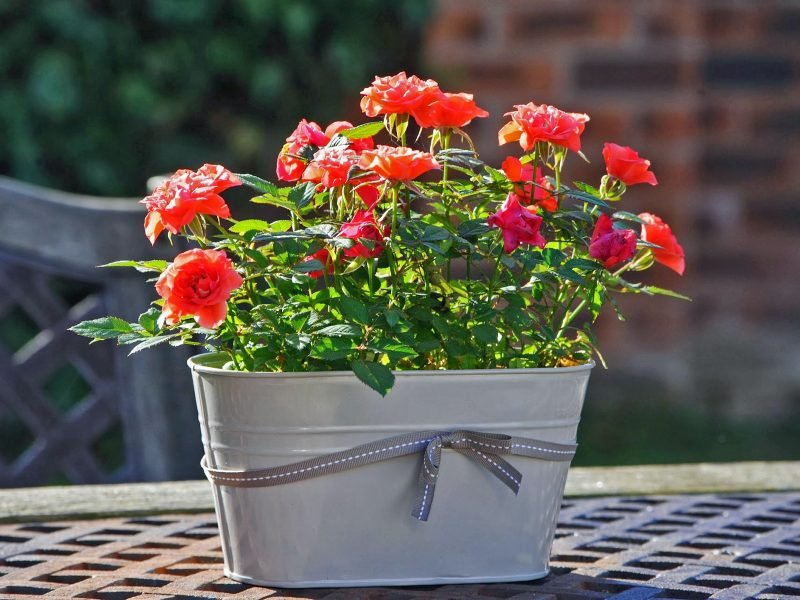
Potted Roses

Small potted roses

Today, we’re diving headfirst into the splendid world of growing roses in pots.

Whether you’re a seasoned gardener looking for a new challenge or a novice just starting your botanic adventure, you’re in the right place. Roses are a delightful addition to any home, bringing a splash of colour and a waft of fragrance.

Ready to get your hands dirty? Let’s roll up our sleeves and plunge into the world of potted roses.

The Benefits of Growing Roses in Pots: Advantages and Disadvantages

Why grow roses in pots, you ask? Well the answer is as colourful as a well-tended rose garden itself. The practice is bursting with benefits; let’s dive in and explore them together!

The Advantages:

  1. Flexibility: Potted roses are the ultimate nomads of the plant world. Growing in containers means being able to move your roses around and create a different look at a moment’s notice.
  2. Control: Growing roses in pots allows you to control their environment completely. You become the master of soil, sunlight and watering conditions.
  3. Less Disease: Roses are a bit like royalty – beautiful, but prone to disease. Growing them in pots can help control common problems like blackspot and rust.
  4. Variety: Pots let you experiment with growing different types of roses that might not thrive in your garden soil.

The Disadvantages:

  1. More Maintenance: Everything is more intense in a pot, including maintenance. You have to water and feed your roses more frequently.
  2. Winter Woes: Potted roses are more vulnerable to harsh winters. You might need to move them inside or keep them insulated.

Choosing the Right Container for Your Roses

Size matters! That’s right, your rose plant isn’t too fussed about minimalism. It needs space. A pot that’s at least 12 to 15 inches deep is ideal. This ensures there’s plenty of room for root growth.

It’s also important to consider what kind of material you want for you pots. Each has its pros and cons. Terracotta and wooden pots are heavy and stable, but they lose moisture quickly. Plastic pots, on the other hand, are and light retain moisture well, but they can be unstable and less durable.

Here’s a quick guide to help you pick:

MaterialProsConsTerracottaHeavy, StableDries out quicklyWoodenHeavy, Organic LookDries out quickly, Can RotPlasticLight, Retains MoistureUnstable, Less Durable

Lastly, don’t forget aesthetics. Choose a pot that complements your space and fits your plans.

Pink roses grown in pots

Selecting the Right Soil for Your Potted Roses

Ingredients for the Perfect Soil Mix

So what makes the perfect soil mix for your potted roses? Here’s the scoop:

  • Loam: Loam is the Goldilocks of soils, not too sandy, not too clay-ey, it’s just right. It has excellent drainage capacity while holding onto the right amount of moisture and nutrients. It forms the base of our perfect soil mix.
  • Compost: This is the magic ingredient that gives your roses their nutrition. It is rich in organic matter, supplying all the essential nutrients for your rose to grow and bloom.
  • Coarse Sand: This aids in drainage, ensuring your roses are never “over-watered”. It’s all about balance, my friends.
  • Perlite: These little white pebbles increase aeration in the soil, giving your roses roots the room to breathe and grow.

The Perfect Soil Mix Recipe

Now you’ve got your ingredients, let’s whip up the perfect soil mix:

  1. Mix two parts loam, one part compost, one part coarse sand and half a part perlite.
  2. Give it a good stir to ensure the elements are evenly distributed.
  3. Fill your pot leaving about 2 inches from the top.

What are the Best Rose Varieties for Container Gardening?

With over 300 species it’s not easy to pick which variety will work for you, not all of those species word particularly well in pots either…

Let’s cut to the chase:

  1. ‘Petit Pink’: A compact floribunda rose. It’s resistant to disease, blooms all season and doesn’t need much pampering.
  2. ‘Blue for You’: Don’t let the name fool you, it’s more of a mauve colour.
  3. ‘Star Performer’: True to its name, this floribunda rose is a showstopper. With vibrantly pink blooms and a moderate fragrance, it’s a pot-friendly pick.
  4. ‘All a’Twitter’: This hybrid tea rose is a beauty. Orange, fragrant, and perfect for pots.
  5. ‘Diamond Eyes’: Petite yet dramatic, this miniature rose variety offers deep purple blooms with a white centre.
  6. ‘Sweet Drift’: Groundcover roses can also thrive in pots, and ‘Sweet Drift’ is proof. It’s disease-resistant, low-growing, and covered with dainty pink flowers throughout the season.

Remember, the best rose variety for you depends on your specific needs and location. So do a bit of research before you get started.

Picking the Perfect Location for Your Potted Roses

It’s got to be just right. Size, light, and temperature all play a part in selecting the best spot for your potted roses.

Light: Roses require a minimum of six hours of direct sunlight each day. So, selecting a sunny spot is crucial. Do keep an eye on scorching midday temperatures in the summer though, nobody wants their roses to wilt!

Temperature: Roses are not fans of extreme weather. They prefer a Goldilocks climate— not too hot, not too cold. So, avoid placing your pots in areas prone to freezing winds or intense heat.

Size: Remember, your roses will grow. So make sure you’ve got a spot that allows for expansion, like a roomy patio or wide window sill. Your roses will thank you for the extra leg room!

Pink potted roses

Watering Your Potted Roses: How Often and How Much?

The ‘when’

You’re looking for that sweet spot where the top inch of soil in the pot is dry to touch. In the peak of summer, this might mean a daily routine, while in cooler months, your roses may only need watering every 2-3 days.

The ‘how much’

You want to hydrate the soil thoroughly, but without water standing on the surface. Remember, roses aren’t fond of soggy feet – excessive water can lead to root rot which is difficult to come back from. Always water early in the day to give your roses a good start, and to allow any excess to evaporate before temperatures drop at night.

  • Observe the dryness of the top inch of soil to determine when to water.
  • Hydrate the soil thoroughly, but without leaving standing water.
  • Adjust watering frequency with the seasons and the plant’s signs.
  • Avoid waterlogging to prevent root rot.

Fertilizing Your Potted Roses: Tips and Tricks

Roses have an insatiable appetite and need a regular dose of nutrients to flourish. So, if you’re wondering why your roses are looking a bit ‘meh’, it’s probably time for some fertiliser.

Picking the Right Fertiliser

Choosing the right food for your roses can feel like walking through a labyrinth. There’s an overwhelming array of fertilisers out there, all promising to give your roses that ‘va-va-voom’. But don’t fret, we’ve got your back!

  • Organic fertilisers: Made from natural materials (e.g., bone meal, fish emulsion), these slow-release options are the preferred choice for many. They not only feed your roses but also improve the soil’s health over time.
  • Chemical fertilisers: These offer a quick nutrient boost, perfect for roses that look like they’ve lost their mojo. Look for a balanced blend, such as a 10-10-10 (N-P-K) ratio.
  • Speciality rose fertilisers: Specifically designed for roses, these contain all the essential nutrients your roses crave. A great ‘no-brainer’ option.

How Often to Fertilise

Roses aren’t shy about wanting a regular feeding. Most will appreciate a good feed every 4-6 weeks during the growing season (spring through early autumn).

Tip: Don’t fertilise your roses just before they go dormant in winter. They’re having a nap, not looking for a midnight snack.

How to Apply Fertiliser

When it’s time, sprinkle the fertiliser around the base of the plant, but make sure you avoid the stems. Then, give your rose a good water to help the nutrients soak in.

And voila! You’re now a certified rose-fertilising guru. Remember, happy roses are well-fed roses!

Pruning Your Potted Roses: When and How to Do It

One of the essential steps you need to keep your roses vibrant and blooming is pruning. Pruning is essential for your roses — it may seem harsh, but it’s for their own good.

When to Prune?

Timing is key when it comes to pruning. The best time to prune your potted roses is late winter or early spring, just before they start to bud. This period allows the plant to recover and bloom beautifully.

How to Prune?

  1. Start by visualising your plant. Before you make a cut, step back and look at your rose bush. Imagine how you want it to look after the prune.
  2. Remove the dead and diseased wood first. These can be identified by the black, shrivelled, or discoloured parts on your plant. Simply cut them off.
  3. Open up the centre of the bush. This step is crucial for good air circulation and to prevent diseases. Aerate your rose bush by removing the branches growing towards the centre.
  4. Prune back to an outward-facing bud. This encourages growth in the right direction. Also, keep an eye on the angle of the cut. It should be sloping downwards to prevent water from collecting at the cut site.

Pruning your roses can feel a bit daunting at first, but with time, you’ll be a pro. Remember, it’s all about helping your roses to grow and bloom in their best possible form. So, don’t be scared to make that cut!

Dealing with Common Pests and Diseases in Potted Roses

When it comes to dealing with pests and diseases in potted roses, it’s all about observation, deduction, and swift action.

The Usual Suspects: Common Pests

First and foremost, let’s talk about the range of pests that can trouble your roses. From aphids to black spot, these tiny critters can wreak havoc if left unchecked.

  • Aphids: These are tiny green or black insects that love to suck the sap from your rose plants. If you spot them, a blast of water or an organic insecticidal soap should do the trick.
  • Black Spot: Not a creature, but a fungus. It looks exactly as the name suggests – black spots on the leaves. Remove affected leaves and use a fungicide to prevent it from spreading.
  • Japanese Beetles: This pest chews on the leaves and flowers. Hand picking them off or using traps are effective ways to control their population.

Unwelcome Illnesses: Common Diseases

Just like people, roses can also fall ill. Here are a few of the common diseases that can affect your potted roses, along with some remedies.

  1. Powdery Mildew: This makes your rose leaves look like they’ve been dusted with flour. Increase air circulation, reduce overhead watering, and apply a fungicide if necessary.
  2. Rose Mosaic: Yellow patterns or mottling on leaves are the telltale sign. There’s no cure, but keeping the rose healthy can help manage the disease.
  3. Botrytis Blight: If you see brown, rotting buds or flowers, it may be this fungus. Remove and discard affected parts and apply a fungicide.

In the world of roses, prevention is often the best cure. Regularly inspect your roses, keep them well-fed and watered, and provide plenty of sunlight and air circulation. Remember, a healthy rose is a happy rose!

Overwintering Your Potted Roses: Preparing for the Cold Months

There’s a few key steps to making sure that your roses safely make it through the winter. It’s nothing to drastic, but these simple checks will ensure the long term health and bring them back to bloom when spring comes around again.

Step 1: Watering and Fertilising

Before the first frost hits, keep your roses happy. Water them thoroughly and give a final feeding. But hold on, don’t overdo it! We want them to slow down and prepare for their winter slumber.

Step 2: Prune for Protection

Next, it’s time to give your roses a good prune. This isn’t just to keep them looking smart. It also helps prevent wind damage by reducing the drag on the plant.

Step 3: Moving to aSheltered Spot

If possible, move your pots to a sheltered spot. It could be against a warming wall or even in an unheated greenhouse. The aim is to give them a bit of protection from the worst of the winter weather.

Step 4: Wrapping Up Warm

Lastly, it’s time to wrap up your roses. You can use bubble wrap, hessian, or even a purpose-made rose cosy. Whatever you use, make sure it covers the pot and the lower stems. But, keep the upper stems exposed to allow air circulation.

In the end, overwintering is all about giving your roses a little extra love during the cold months. Follow these steps and look forward to a spectacular show come spring.

Troubleshooting Common Problems with Your Potted Roses

Fiddle and Thorn is a participant in the Amazon Services LLC Associates Program, an affiliate advertising program designed to provide a means for sites to earn advertising fees by advertising and linking to Amazon.com

Take our houseplant survey!

Quickly respond to our 30 second houseplant survey and get 75% off our Complete Houseplant Care eBook!

Take the Survey

No thanks…

How to Grow and Care for an African Mask Plant

Last Updated: May 15, 2023

With their unique and striking leaf patterns, African Mask Plants are not the easiest houseplant to care for. But don’t let that put you off; they are worth the extra hassle.

Native to the tropics of the South Pacific, African Mask Plants have thick veined leaves which almost look like masks which is where that name comes from. With the Latin name Alocasia Amazonica, the African Mask Plant is also commonly known as an Alocasia Polly or a Kris Plant.

How to Care for an African Mask Plant

These plants definitely aren’t the easiest to care for as they do have some more specific requirements which means they don’t qualify as a low-maintenance houseplant in our eyes unfortunately. However, most of the trouble comes with finding a good spot for your plant so once that’s done, a lot of the other things will become a lot easier.

The number one thing that plant parents need to know when growing and caring for an African Mask Plant is that they require a high humidity level. If grown in dry air, the leaf tips and edges will quickly dry out, turning brown.

Another thing to note is the need for bright but indirect light. Your plant will struggle in extremes of bright, direct light and low light areas and it will start to cause irreversible issues quite quickly. We’ll explain more of this below alongside a full and comprehensive overview of how to care for your African Mask Plant.

African Mask Plant Overview

Origin: Tropics of the South Pacific region

Latin Name: Alocasia Amazonica

Common Names: African Mask Plant, Alocasia Polly, Kris Plant

Plant Family: Araceae

Difficulty Level: Medium

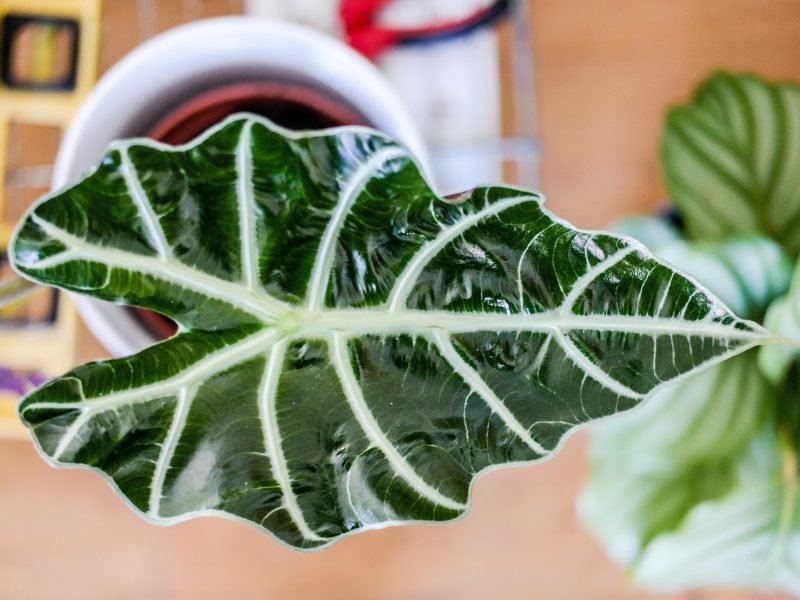
Appearance: Dark green waxy leaves with thick yellow/white veins. The leaf shape is an elongated heart or arrow.

Height and Size: Maximum height of around 2-4 feet as they are bred smaller than other alocasia varieties.

Growth Rate: Medium

Light Requirements: Bright but indirect light. Avoid direct sunlight or low light environments.

Water Requirements: Moderate watering in summer to avoid soil drying out for extended periods.

Best Soil: Well-draining, nutrient-rich potting mix.

Flowering: Can rarely produce small white flowers during summer.

Pruning: Only to remove discoloured leaves

Cleaning: Dust frequently to remove dust

Ideal temperature: 65-85°F (18-29°C)

Fertilizing Routine: Apply a well-balanced fertilizer at half-strength every 1-2 months during spring and summer.

Ideal Humidity Level: 50-70% humidity is ideal

Propagation: Division of the mother plant

Repotting Frequency: Every 2-3 years

Toxicity: Toxic to dogs and humans as they contain insoluble calcium oxalate crystals.

Risk of Pests: Spider mites, whiteflies, scale insects and aphids

Common Problems: Dry leaf edges and tips and brown or yellow foliage.


Origin of an African Mask Plant

They are native to the tropics of the South Pacific region. Their native environment tells you a lot about their environmental requirements in your home as they love high humidity and warmer temperatures.

African Mask Plant Family

Alocasia Polly plants are part of the Araceae family. This is a plant family made up of over 3,000 species, all of which are flowering plants which create a type of inflorescence which is known as a spadix. (More on that in the flower section below).


African Mask Plant Leaves
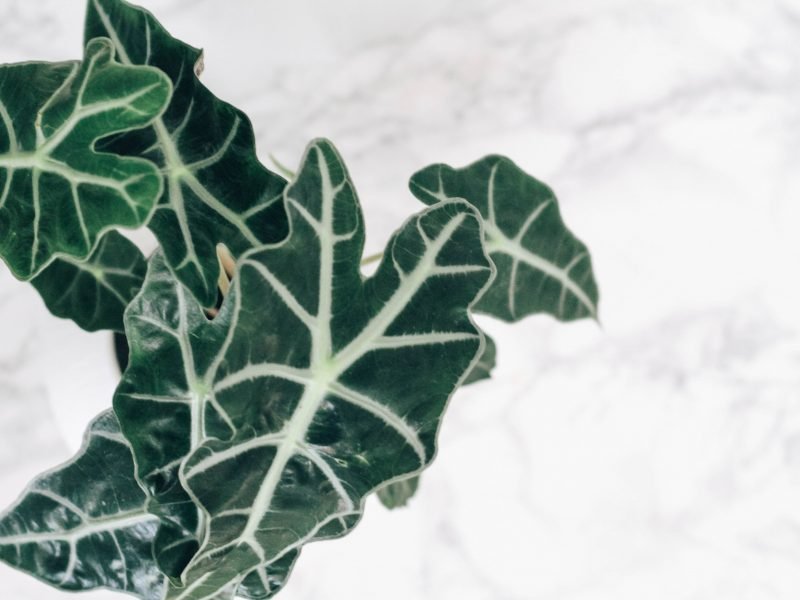
African Mask Plant on a marble table

African Mask Plant Appearance

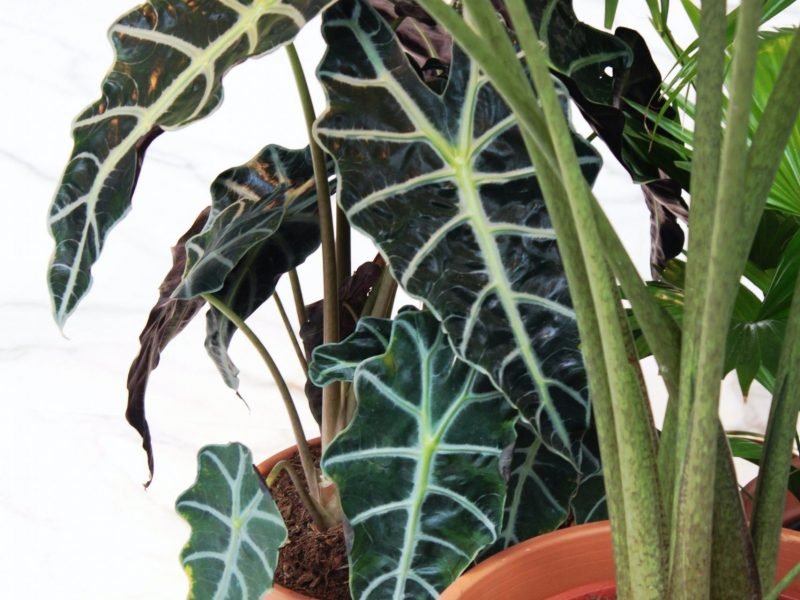
Known and loved for their thick dark-green waxy leaves, African Mask Plants have prominent yellowy/white veins throughout. Their leaves are quite shield/mask-like which is where it gets its common name.

African Mask Plant Height and Size

The varieties that are grown indoors can reach heights of 2-4 feet at a maximum, although, in their native environment, African Mask Plants can grow a lot larger and taller.


Growth Rate of an African Mask Plant

During summer, African Mask Plants have a moderate growth rate so you will see new leaves popping out every few weeks. However, like most other houseplant types, they will go dormant throughout autumn and winter and you won’t tend to see much if any new growth during that time.

If there is a new leaf growing in the colder, darker months, it will often be a lot smaller in size compared with the rest of the plant.

Flowers on an African Mask Plant

Mature African Mask Plants can produce small white flowers. However, this is rare when grown indoors. The spadix flowers are white, small and very insignificant. We often remove them before they bloom to allow the plant to redirect energy to new healthy leaves.

Pruning your African Mask Plant

One great thing about growing and caring for these plants is that they don’t require regular pruning. We only recommend pruning a leaf from your African Mask Plant if it has discoloured (ie. turned brown or yellow).

Cleaning your African Mask Plant

As with any houseplant with large flat leaves, African Mask Plants are prone to a build-up of dust. Make sure to wipe the leaves down with a damp cloth every few weeks.

If this is not enough to remove the dirt from the leaves, use a few drops of dish soap. Avoid using any harsh chemicals on your plant as this can damage the leaves.

Some plant parents turn to leaf shine to make their plants look extra shiny. However, we strongly advise against it as it can actually strip your plant’s leaves of a natural protective layer.

Once the majority of the leaf has discoloured, it won’t be valuable to your plant for the photosynthesis process so it’s best to remove it.

Remember, when pruning your African Mask Plant, use clean, sharp shears and wear gloves as they are toxic.


Alocasia Polly Plant
Alocasia Polly Plant

African Mask Plant Sunlight Requirements

African Mask Plants struggle in low light and bright, indirect sunlight. The ideal place for your plant is a spot with nice natural bright but indirect light.

If your plant receives too much intense direct sunlight during summer, it can dry out, scorch and burn the leaves. While you can get away with direct light during winter, make sure to move your plant when the warmer weather comes around.

If you’re unsure of whether or not your plant is getting enough light, we recommend picking up a light monitor. They can help you spot changes throughout the day and figure out if your plant is getting too much or too little light.


Water Requirements for an African Mask Plant

African Mask Plant require moderate to frequent watering but not with a large volume of water at once. They don’t want their soil to dry out, but they also don’t want their roots to become waterlogged. This is why a little but often approach works best to ensure your plant continues to thrive.

It’s best to continually monitor the moisture level of the soil and adjust your watering habits accordingly, rather than sticking to a regimented watering routine. There are so many factors that impact how quickly the soil dries out, for example, plant size, temperature, and light level so there is no one-fits-all timeline that will work all year around.

We often use a moisture meter to help us know exactly when our plant needs water and it has saved our plants many many times!


Best Soil for an African Mask Plant

Choose a well-draining, high-quality, nutrient-rich potting mix with good aeration qualities. Make sure the potting mix includes perlite as this helps both drainage and aeration.

It’s also good to have peat (or a peat alternative) in the potting mix to help some retention of the water to ensure it doesn’t dry out too quickly. Getting the right balance is key.


African Mask Plant Temperature Requirements

Alocasia Pollys require a temperature of between 65-85°F (18-29°C) to thrive. When grown in colder climates, growth will be slower and the risk of root rot is higher.

Make sure to keep them away from drafty windows or air conditioning vents where they might experience cooler temperatures. At the same time, you want to avoid placing them too close to radiators or heating vents as hot temperatures will dry out your plant more quickly.

A digital thermometer is a great way to know for sure if your plant is in the right spot and monitor any extremes so you can fix the issue before it’s causing problems for your African Mask Plant.


African Mask Plant Fertilizer Requirements

Fertilize your Alocasia Polly once every 1-2 months during spring and summer. Use a well-balanced, liquid fertiliser at half-strength to avoid over-fertilization. This can damage and burn the leaves so make sure to dilute it properly.

It is very important that you only feed African Mask Plants during spring and summer as this is the main growth period.


African Mask Plant Humidity Requirements

Alocasia Pollys require a humid environment of between 50-70% humidity. They require a humid environment as they are native to the tropics and will struggle to grow in dry air (this can cause dry brown leaf tips, edges and eventually entire brown leaves).

There are several ways you can increase humidity levels which we explain further in our humidity guide. The easiest way to increase humidity levels is by using a humidifier or by getting into the habit of misting your plant at least several times per week.


Healthy African Mask Plant

Healthy African Mask Plant

Propagating your African Mask Plant

As your African Mask Plant matures, you might want to think about propagating if the plant becomes too big for the space. Carefully take the roots out of the pot and separate the root systems with your fingers.

Unfortunately, as they grow from one central rhizome, you can’t propagate through stem cuttings and division of the mother plant is the only option.

We have written a detailed guide on propagating your African Mask Plant so check that out for a detailed step-by-step guide, FAQs and top tips to remember along the way.


Repotting your African Mask Plant

Alocasia Pollys like being slightly rootbound, so you will only need to repot your plant every 2-3 years. We still recommend occasionally checking for signs that your plant is too rootbound. These include roots growing out of the drainage holes, roots growing out of the soil at the top of the pot, the roots being very tightly coiled when removed from their pot and a lack of new growth in summer.

The best time to repot would be in spring as the growth period approaches so that the plant can get used to its new environment and shock will be easily overcome.


African Mask Plant Toxicity to Humans and Pets

Unfortunately, African Mask Plants are toxic to pets and humans as they contain insoluble oxalate crystals. Because they are insoluble, they do not dissolve when they come into contact with moisture in the mouth. Instead, these crystals can cut the inner mouth and throat tissue.

If part of the plant is ingested, this can cause burning and irritation of the mouth, throat and stomach. It can also cause vomiting and wheezing in cats and dogs.

We highly recommend seeking medical advice and treatment if any part of the plant has been ingested.


Treating and Preventing Pests

While a pest infestation is rare, African Mask Plants can suffer from spider mites, whiteflies, scale insects and aphids.

The first thing to do if you spot pests (or signs of them) is to isolate your plant from all other houseplants to avoid the infestation spreading. Then remove the worst affected areas of the plant as this will simply reduce the number of pests which makes the infestation easier to tackle.

Start treatment with neem oil and an insecticide to remove the pests. You also want to continuously check over any other houseplants as pests can easily spread between plants close to each other.


African Mask Plant Common Problems

Fiddle and Thorn is a participant in the Amazon Services LLC Associates Program, an affiliate advertising program designed to provide a means for sites to earn advertising fees by advertising and linking to Amazon.com

Take our houseplant survey!

Quickly respond to our 30 second houseplant survey and get 75% off our Complete Houseplant Care eBook!

Take the Survey

No thanks…